Posts

This work is based on a true story as fictionalised in a made-for-TV movie as reinterpreted in an evening-length dance performed by swans and handpuppets

One of the common turns or tricks used for program or liner note in recent music is that in which the composer identifies his or her work as based on X   [where X = some story, novel, painting, dance, film, poem, sculpture, installation, video, TV or radio serial, building, mathematical/physical/biological property, function or feature, philosophical idea, etc., take your pick]   and this reference may, in some cases, be interesting, useful, provocative or otherwise of value to the reader-who's-about-to-become-a-listener.  Composers are frequently interesting people with non-trivial interests in any or all of these things, and sometimes these interests get wrapped up in non-trivial ways with their compositional production.  But not always.  Sometimes a reference like this can come off as obscure, unhelpful, or even appear to be pretentious to the reader-who's-about-to-become-a-listener.  (Let's face it, many composers are sometimes, often, or even alway...

Paying Attention

A friend asked me the other day why I had been spending so much time of late with the music and writings of some composers who were not exactly experimentalists, including names like Milton Babbitt, Seymour Shifrin, Nicolas Nabokov, William Denny, Ben Weber, and Roberto Gerhard.  Indeed, some of these were, as both composers and actors in the musical world, active opponents of the experimental.  The answer was that although each of these musicians did work that was distant from my own disciplines and tastes and, to my ears, moved mostly into musical-historical cul de sacs, they were working seriously and musically and my sense of ecology within the musical world was such that I couldn't ignore that seriousness and musicality, let it go to waste, let alone lose the opportunity to explore for myself some of the musical potential that might be left in those cul de sacs .  So, I have no apologies for spending time with a Gerhard Symphony that brilliantly incorporates electroa...

With Four Melodicas You Can Do Anything

If you're in London on the 5th of July, the next season of Music We'd Like to Hear begins with an ensemble concert curated by Markus Trunk.  And yes, one of my pieces is on the program.  Concerts curated by John Lely and Tim Parkinson featuring solo violin and cello respectively follow at one week intervals. Fridays, and all at the Church of St Mary-at-Hill, off Eastcheap, London EC3R 8EE

Those added degrees of freedom

Eight weeks after having a heating pipe bust, with the insurance company willing and the plumbers & painters & floorers finally done with their work, (and perhaps the good will of a couple of benevolent pagan demi-Gods,) we're finally in a position to put the furniture back in the living room.  And* with walls and floors and celing looking fresh and new, the temptation to reposition the furniture is great, a chance to make our old familiars (tables, chairs, sofa, cabinets, lamps, home entertainment devices (piano, harpsichord, music stands, the electronica), pictures) somewhat less familiar.  But our stuff , less chosen than accumulated, none of it especially valuable or (one drawing excepted) attractive, our stuff entered our house piece-by-piece over many years, each piece chosen largely on the basis of being able to fit into whatever space the existing piecery left vacant, so that the number of possible repositionings in the room is greatly limited and the number of...

Alphabetized Winterreise

Here's a new score by Eric Carlson, a composer previously unknown to me, Alphabetized Winterreise .   The piece is exactly what the title says it is: Schubert's song cycle Winterreise , disassembled into its individual words which are then reassembled in alphabetical order.  There is some precedence for such re-assembly of the contents of an existing work (Christopher Hobbs's The Remorseless Lamb does, measure-for-measure, something of the sort, and both polyphonically and randomly, for a four-hand arrangement of Bach's Sheep May Safely Graze ) and there is a body of experimental literature in which alphabetizing lexicons of texts is a formal move (Walter Abish has done this brilliantly, first a paragraph, then the alphabetized list of words which, emptied of their word-order-driven syntax, have a emotional power of their own.)  But Carlson's piece seems to me to be a uniquely virtuoso effort within this field, and reading through the score has been an experience ...

A little less consorting, please.

One of the commissioning trends of late has been for several performers or groups, from chamber musicians to choirs and orchestras, to jointly commission a new piece from a composer, with the prospect of multiple performances of the work more-or-less guaranteed.  While all commissioning is good and pooling resources is usually good, and the promise of performances beyond a premier is always good, I think that a greater good to the diversity and liveliness of our musical lives would be done by if all the individuals and organizations interested in commissioning new work would each commission a new work from a different composer. Yes, this more than likely means much smaller commissions, but the commission is basically a gift upfront and is only part (and the least reliable part) of the composer's complete compensation package. That guarantee of a first performance might compensate significantly for a significantly more modest commission when coupled with a second or third performanc...

Delicate or robust?

Composing blogger James Ricci, in an item about his mentor, Milton Babbitt , recalls one of the too-many Babbitt stories about a premiere performance shortchanged by inadequate rehearsal.  In this case, an orchestra's inadequate rehearsal time for a Babbitt piece was compared with the apparently over-generous rehearsal for a repertoire warhorse which shared the program, Rimsky-Korsakov's Sheherazade .  The complaint was, more likely than not, justified, but attempting to reconstruct the rationale behind such a rehearsal schedule might be more than an idle exercise and may, in fact, reveal something interesting about how repertoire is handled in real life by the institutions which dominate concert music-making. From Babbitt's point of view, his work — here, Ars Combinatoria , but the understanding is general to his catalog, not specific to this chamber orchestra piece — was something rather delicate, with every detail projecting and embodying its underlying structures, thus...

Lost Thread

For all my engagement with formal experiments in my music, usually involving extensive planning, research, development, design, calculation etc., as often I just compose from brute force, drawing a continuous thread of music which starts someplace and goes wherever it (through that mysterious combination of habit, taste, caprice, and imagination) happens to lead.  But such unplanned excursions carry more of a particular risk than the planned journeys, as they depend — at least for me — on having a great deal of continuity in the compositional time and environment. When that continuity is broken, the thread can get lost and sometimes irretrievably so. Then you're left with fragments (which could be useful), outright abruptions (which could be useful), or fragile, tentative, questionable, or even broken continuities (which could be useful as well: think exquisite corpses .) (But could be useful is not necessarily useful .) A broken heating pipe is never expected and the pipe (yes, i...

Martial

Image
I was in marching band for exactly one summer, the summer before I started high school.  Although I began with high expectations for marching, as a trombonist, in the front row of the Montclair, CA High School Marching Cavaliers in their smartly tacky Columbia Blue and Black uniforms, I quickly found out that I didn't like marching and marching didn't much like me. Not yet 14 and already over six feet tall,  I was at precisely that awkward moment in pubescent motor development when control over my limbs was more a matter of random nervous system activity than the control required for marching, enough so that I was, honestly, very bad at it (once obliviously and famously marching several complete rounds of the parking lot with each sides' arm and leg in complete synchrony, just the opposite of how it's naturally — and supposed to be — done), but I probably could have gone along with the program had I actually liked the music. For each morning spent that hellish summer ma...

On not being a film composer

I'm from Southern California, east of L.A. and grew up in in environment where film, no, movies had a deep presence.  I loved (and love, though parental responsibilities have slowed down the pace) going to the movies and watching old favorites or new discoveries on late night TV (for which German TV can be good.) Sometime in high school, something clicked and I suddenly had a revelation that movies could be more than just entertainment, they could intersect with the real world in unexpected ways and use the manipulation of time, sound, and image to tell me things about the world, sometimes shocking things, that I didn't know before.  The could help make the world more interesting and lively, creating opportunities for reflection and action.  Movies became almost as exciting as music.  What I liked, and like, most about watching film was/is paying close attention to details:  a line of dialogue written and executed supremely well, an uncannily timed cut, secret ...

Kraig Grady on Erv Wilson

This is a nice informal video of composer Kraig Grady talking about his studies with music theorist Erv Wilson.  I'm also a student of Wilson's, having my first lesson with him while I was still in high school.  He lived (and still lives) in one of the oldest houses in the Highland Park area of Los Angeles, a wooden place (the stone chimney fell in an earthquake a couple of decades ago) high above Arroyo Seco, now the oldest section of the the west's oldest freeway.  The terraced garden in front of the house was planted with corn seedlings (later to be joined by chenopods) which, I would learn, he bred from wild plants and old cultivars he had gathered, to plant on his family's ranch in the mountains of Chihuahua, where he had been born. (Wilson speaks English with a slight trace of Chihuahuan Spanish.)  The inside of his house was full of guitars fretted in unusual ways, not one of them with twelve equal steps to the octave, bamboo and wooden flutes from South Ameri...

Around and about

Here are a few blogs and sites that have turned up recently: Sound Expanse , composer Jennie Gottschalk Detemporalizing , composer & poet Samuel Vriezen, now blogging in English Desiring Progress , pianist & musicologist Ian Pace Composer Daniel Goode New Musical Resources ,  trumpet player & musicologist Peter Gillette Classical Music is Boring , photo funnies Well-Weathered Music , composer Miguel Frasconi The Great (un)Learning , composer Christopher Shultis Helen Bledsoe, Flutist , exactly that Essays & Endnotes , theorist Stephen Soderberg Divergence Press , a new web magazine

Landmarks (50)

Luigi Dallapiccola: Quaderno musicale di Annalibera (1952) for solo piano. A set of 11 small pieces or movements, intended to be played all together in sequence, at once individual character pieces (some with particular technical concerns ("Accents", "Rhythms", "Colors") and variations or variants on/of common material (a single 12-tone row in transposition and in its classical transformations). Some of the pieces are aphoristic in length, others a bit more substantial, the whole perhaps 14 minutes in duration. Much has been noted about the 12-tone aspects of the piece — I can recall, as a 14-year old, working out those rows as if they were the more sophisticated thing in the world, and yes, I'm a bit surprised to be including two mid-20th century 12-tone pieces in a row in this list of personal landmarks — as well as the connections to Second Viennese School (not least to piano pieces by Schoenberg and Webern * ) and further back, through both the st...

What composers mean when we say we're "writing" music

The usual assumption is that we're producing notation, putting notes down on paper (or, more recently, pushing pixels around a screen to emulate putting notes down on paper) just like Sebastian Bach did when he adjourned to his composing room each evening, lubricated by a bottle of brandy and powered by some costly candles (the costs of those candles alone had to have put Bach among the relatively well-off in his day.)  But that's not broad enough to describe the diversity of what we do.  Composing is also "writing" when we're committing something to a text or graphic score, or programming in some language or code, or committing something to memory.  I just read an interview with David Tudor, who also used the word writing as the verb associated with pieces he made even when they had no notation at all: perhaps some tentative oral instructions (when others were involved), sometimes circuitry diagrams or often just the circuits themselves, especially when the work ...

Landmarks (49)

Roberto Gerhard: Concert for 8 (1962) for flute, clarinet, guitar, mandolin, accordion, percussion, piano, and double bass. The Catalan composer Gerhard (1896-1970) was one of Schoenberg's Berlin students (an international group that included Nikos Skalkottas, Marc Blitzstein, Norbert von Hannenheim)  and his career bridged over the Second World War, giving an unusual breadth with some of his early works incorporating folk elements, his latter works using twelve tone techniques, electro-acoustic tape, and even some degrees of Cage-acknowledging indeterminacy.  Fleeing Franco's Spain, his latter career was spent in England, with some important teaching stays in the United States. Gerhard's use of Schoenbergian  twelve-tone techniques was sensitive and sophisticated, but the twelve tone aspect is perhaps the least interesting thing about the Concert for 8 :   it can say something about where the pitches come from, but this music is about far more than pitches and ...

Metre: The End of the Line

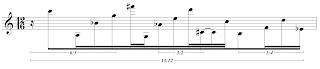
I'm in the middle of an old-fashioned exchange of letters (envelopes, stamps, mailboxes, everything but the pony express) with an old friend about poetic and musical metres. (It's a fascinating, if often confusing field, not least because poets and musicians tend to count things — metre, feet, stress, accent etc. — slightly differently (in particular, as a musician, I think I recognize an anacrusis — a pick-up —  more readily than most poets do. (Entertainingly fictionalized, and in his usual obsessive style, Nicholson Baker's novel The Anthologis t treats this question.))) I think we have reached some consensus that song and dance metres differ from each other in a fundamental way in that dance assumes, indeed requires (i.a. so that dancers don't fall over themselves trying to follow a stretch of music when a foot/beat too many or too few appears or doesn't) a continuity from measure to measure, a non-stop flight of music (the music always goes on, and sometimes it...

The New Division: New Music for Recorder

Image
I'm very pleased to announce an online publication, The New Division , a collection of works by a large and international group of composers for solo alto recorder with or without accompaniment, based on ground basses found in the The Division Flute of 1706. The Division Flute , published by John Walsh, was a collection of pieces for solo treble/alto recorder, mostly with accompaniment by continuo bass playing repeated grounds.  (The collection also included a number of unaccompanied preludes, chaconnes, and Cibells (a gavotte-like dance based on a hit tune by Lully.))  Like similarly-named collections for the viol (which has been lost) and violin, it provides one of the best insights into the state of the art of instrumental music-making — from amateur to virtuoso — in its time. The art of playing divisions — or, if you like, diminutions or variations — to an existing piece of music or over a repeating bass line and/or harmony was a central part of Baroque musical practice b...

In Our Theatre

Image
Around the middle of the 20th century, one cutting edge of American poetry found its theatre of operations* in the line, flexible in length (sometimes brief, sometimes extending so far past the edge of the page that it is graphically split and begins again at an indent, perhaps several indents for the long-winded), perhaps tied to a speaker's breath, certainly marking phrases and junctures in the poet's thought.  (See, certainly, Charles Olson's essay Projective Verse .) The line took over the weight which it had previously shared with couplet-ed pairs, stanzas, verses. At the same time, the line in this repertoire, generally speaking, was one without any of the traditional regulatory instruments of rhyme, metre, stress, and/or accent associated with lyric (but each available in principle as an optional local feature.) Similarly, in some music, particularly the most densely notated, the theatre has shifted from the phrase — usually identifiable by a thorough-going line of s...

Joseph Byrd re-encountered

Good news:   New World has released an album of works by Joseph Byrd , played with stylistic certainty by ACME, oka the American Contemporary Music Ensemble.  Byrd's music has long been an enthusiasm in these parts, and having these pieces from the early 1960s available goes some distance to recovering the diversity of the radical music of that era, particularly its west coast roots and branches.   Byrd connects to Young and Riley in the Bay area and later to Cage, Ono and Thomson in New York, but also to Douglas Leedy, but also should make us pay greater attention to the orbits around Barney Childs  (while we're at it, let's get some performances of Childs' Four Pieces for Six Winds , soon, with its desert-drawn gamut studies) and Harold Budd (Budd, of course, is the L.A. connection to both David Cope and James Tenney, from Budd and Childs, you also reach into the realm of Peter Garland's Soundings and Jim Fix's Cold Blue label.) In addition to the recovery o...

Lucier Introduces

Overthe course of four decades at Wesleyan University, Alvin Lucier taught an open-enrollment undergraduate course, an Introduction to Experimental Music , coded for the catalog as Music 109.* Wesleyan University Press has just published a book titled just that, Music 109 , collecting Lucier's lecture notes for the course.  It's a highly personal guided tour through an exciting repertoire, with Lucier's notes more or less in their rough-but-ready-for-extemporaneous-elaboration original form, organized by a series of intriguing topics (from Indeterminacy and Graphic Notation to Repetition, Long String Instrument, and Words) and made more compelling for the lay reader by being told as much in the form of stories and anecdotes as in historical or analytical prose.  He doesn't attempt to analyses anything in great depth, but instead picks a feature or two from each work discussed, piquing curiosity and giving the new listener a handle onto music that might otherwise escape,...